Dr. Panda Racers
- 3.9
- Rating
- 50.00K
- Installs
- $3.99
- Price

 Analysis by App-foxy
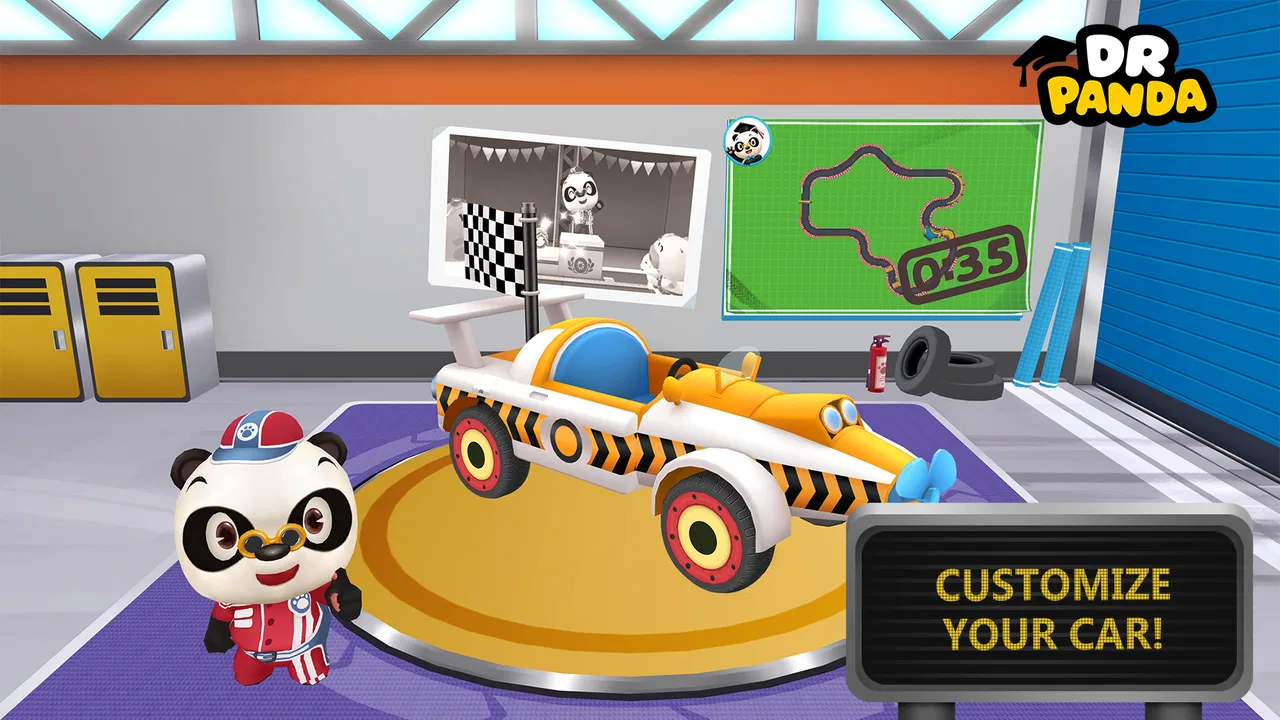
What caught my attention in Dr. Panda Racers is not simply that it is a racing game. Its central idea is that the player helps assemble a car and create a track before racing on it. That changes the experience from a quick “choose a vehicle and drive” activity into a small creative routine: make something, test it, adjust it, and try again. For younger players especially, that extra step gives each race a personal connection.
I reviewed this family-friendly racing game from Dr. Panda with that capability in mind. It is designed for Everyone, costs $3.99, and sits in a very different place from competitive racers built around realistic handling, rankings, or complicated upgrades. The appeal here is control over the setup rather than speed alone. I found it most enjoyable when I treated the track builder as the main activity and the race as the payoff.
The game has an average rating of 3.9 from around 400 ratings, with over 50 thousand installs. It first appeared on May 19, 2016, and the current version is 26.3.14 for devices running Android 7.0 or later. Those details matter because this is an established, modest-sized title rather than a new blockbuster racing game. I would approach it as a focused paid experience for children and families, not as a replacement for a full console-style racer.
You May Also Like

 Blood Strike: 2.5 Anniversary
Blood Strike’s Loadouts Turn Every Drop Into a Tactical Gamble
A close look at Blood Strike’s custom loadouts: how fast access to signature weapons reshapes its battle royale rhythm, rewards preparation, and narrows the gap between fights.

 Pandora - Music & Podcasts
Pandora’s Music Is Easy to Start, but Harder to Recover
Pandora’s strength is its low-effort path from a seed to a station. Its weak spot is how much confidence it asks you to place in connection, setup, and quiet recovery.

 8 Ball Pool
 Is Built on Rivalries, Rematches, and Routine
A close look at the rivalries, rematches, shared routines, and unanswered safety questions that turn a quick pool match into a persistent mobile community.

 Samsung Music
’s Quiet Strength Is Playing What You Already Own
Its reach comes less from spectacle than from dependable access to a personal library. That simplicity is both the app’s strongest retention engine and its ceiling.

 AccuWeather: Weather Radar
AccuWeather Review: A Quick, Clear Forecast for Everyday Decisions
For everyday plans, the best forecast is the one you can understand quickly. AccuWeather makes rain timing, radar, and local conditions easy to act on, with a few trade-offs.

 Hill Climb Racing
Why Hill Climb Racing Still Turns Crashes Into One More Run
A tiny car, a bumpy hill and one more upgrade: Hill Climb Racing keeps resurfacing because its simple chaos makes every near-miss feel personal.
More From Our News Desk
View All News


Building the race is the real feature
I find the early goals easy to grasp: prepare a car, make a course, then see how the idea works in a race. That gives a child a clear first task without asking them to learn a complex racing routine. The useful question is whether making the setup feels fun in its own right, because that shapes how the game’s progress signals land next.
Why assembling the car matters
The car-building element gives the player a sense of ownership before the race even begins. Instead of dropping straight into a fixed event, I can take part in preparing the vehicle and then see the result move around the course. For a child, that sequence is easy to understand: the car is not just an icon selected from a menu; it is something they helped put together.
This is a useful distinction from many simple mobile racing games. In a typical arcade alternative, the main loop is to start a race, steer, collect something, and repeat. Here, the construction stage creates a natural pause. It encourages children to look at the vehicle, make a choice, and connect preparation with the next action. That makes the game feel less like a reflex test and more like a playful project.
I also think this structure helps parents who want a game that can be discussed rather than merely watched. A child can explain why they chose a particular setup or show the track they made. Even without turning play into a lesson, the game creates openings for simple conversations about planning, sequence, and cause and effect.
Track creation gives each race a purpose
The track-building capability is the stronger of the two ideas because it directly affects how the race feels. A course made by the player has more meaning than a course selected from a list. When I returned to a track after racing on it, I had a reason to change the layout: perhaps the route was too easy, too awkward, or simply ready for a different arrangement.
That loop is the most important thing to understand before buying. If someone expects a large collection of professionally designed circuits with deep competitive progression, this will feel limited. If they enjoy making a small course and immediately testing it, the same design becomes the game’s biggest strength.
There is also a practical benefit for short play sessions. A child does not need to finish a long championship or remember a complex upgrade path. They can spend a few minutes putting together a course, race it, and stop after seeing the result. That makes it easier to fit into a quiet break, a waiting room, or a brief family activity.
A creation-first racing game, not a simulation
I would not recommend approaching this as a realistic driving simulator. The category is racing, but the emphasis is clearly on accessible play and personal construction. The enjoyment comes from the relationship between the pieces you arrange and the race that follows, not from mastering detailed vehicle physics or shaving tiny fractions from lap times.
That makes it more approachable for younger players who may find conventional racing games too fast or too demanding. It also means experienced racing fans may find the driving itself too light. The game works best when the player wants to create a playful situation, not when they want a serious test of braking points, overtaking strategy, or car tuning.
How the loop feels in everyday play
Rather than relying on a long checklist of targets, the game’s most visible sign of progress is the change between a first course and a revised one. I’d encourage a player to remember one thing they want to improve, then alter only that part before racing again. That makes each attempt easier to judge and sets up a fair look at how the challenge develops.
Start with a simple course
My advice is to begin with a straightforward track instead of trying to make the most elaborate route immediately. A simple layout makes it easier to understand how the building choices translate into the race. Once the player knows what the course feels like, changing one part at a time becomes more rewarding than rebuilding everything without knowing what caused the difference.
This is one of the less obvious ways to get more from the game: treat the first race as a test rather than a final result. Afterward, ask what was enjoyable and what was frustrating. If the route feels repetitive, alter its shape. If the race is confusing, simplify it. The game’s creative value comes from this small cycle of observation and revision, and rushing past it reduces the feature to a one-time novelty.
Use the race to evaluate the build
The racing portion is most useful as feedback. It shows whether the vehicle and track combination works in practice. That is a better mindset than expecting every creation to be perfect on the first attempt. Children can learn that changing a design after testing it is part of making something, not a sign that the first attempt failed.
For parents, this also offers a calmer way to participate. Rather than taking over the controls, I would ask the child to predict what might happen before starting the race. Then the result becomes something to compare with that prediction. This keeps the child in charge while giving the activity a little more structure.
Another useful habit is to avoid rebuilding immediately after a disappointing race. Let the player describe the problem first. Was the course boring, difficult, or simply not what they imagined? That distinction helps them make a purposeful next choice instead of tapping through options at random.
Keep expectations realistic on a phone or tablet
This is a compact mobile game, so its strength is accessibility rather than breadth. I would expect it to work best as a self-contained activity that can be picked up without a long explanation. It is suitable for a child who enjoys making and trying things, but less suitable for someone who needs constant novelty, a large roster of vehicles, or a strong sense of long-term competition.
The paid price is part of the experience to consider. At $3.99, the purchase makes more sense for a family seeking a focused game without building the decision around competitive features. A child who plays it repeatedly because they enjoy designing tracks may get good value. A child who only wants fast races and quickly loses interest in construction may not.
What the age rating tells me about the audience
The Everyone rating fits the gentle, accessible direction. I would place this closer to a shared family game or an early independent play choice than to an intense racing title for older players. That does not mean every child will like it. Age suitability and personal interest are different questions: a child can be perfectly comfortable with the game and still prefer a faster, more action-heavy racer.
For a younger player, I would initially sit nearby and see whether the building choices are understandable without help. The best experience is one where the child can take ownership quickly. If an adult has to make every decision, the creative feature loses much of its value.
The best everyday scenario for this game
The challenge here comes less from mastering technical driving and more from deciding what to build and whether it works as expected. A simple route is a sensible starting point; adding complexity only after a child understands the race makes experimentation feel purposeful instead of confusing. That gentle approach also reveals where the game’s pacing may or may not hold attention.
A short shared activity before moving on
The strongest scenario I can imagine is a parent, sibling, or caregiver sitting with a child for a short creative session. The child assembles the car, builds a track, races it, and then explains what they would change. This gives the game a clear beginning, middle, and end without requiring a long commitment.
It also works well when a child wants to show an adult something they made. The adult does not need to be familiar with racing games to participate. They can ask which part of the track is the most fun, whether the car feels ready, or what should be changed next. Those questions support the game without turning it into a formal activity.
I would be less enthusiastic about using it as a distraction that must hold attention for a long stretch. Its construction loop may be engaging, but it is not the same as a deep progression system. Once the player has explored the kinds of creations they enjoy, the experience depends on whether making another variation still feels worthwhile.
A useful way to play with two children
With siblings or friends, the track-building capability can become a simple turn-taking activity. One child can prepare the course while the other predicts how it will feel, then they can swap roles. This gives the game a social rhythm without requiring a formal multiplayer competition. The important point is to make the creation itself the shared event, rather than letting one child control everything.
There is a trade-off here: children who strongly prefer winning may focus only on the race and become impatient during construction. In that case, short turns and deliberately simple tracks are better than asking them to design a complete course every time. The game is at its best when both players accept that making the setup is part of the fun.
Why it suits creative children more than competitive ones
I would hand this to a child who likes arranging objects, inventing routes, and seeing an idea come alive. The game rewards curiosity and repetition. A child who enjoys drawing roads, building with toys, or changing a setup to see what happens is more likely to appreciate its central loop.
By contrast, a child who asks for faster cars, tougher opponents, detailed customization, or online competition may feel that the creative stage gets in the way. In that situation, a conventional arcade racer is probably the better choice. The deciding question is not “Does this person like racing?” but “Do they want to create the race before driving it?”
Where the design makes compromises
I see the main retention pressure as self-directed: the player returns when they want to try another creation, rather than because a competitive ladder demands it. That can make the game relaxed and easy to put down, but it also means a child who wants constant new goals may lose interest. The distinction matters when deciding whether its modest, creative loop is enough for your household.
Creative freedom can feel smaller than expected
Track building sounds expansive, but in practice any mobile creation system has to keep its choices understandable. I found that the feature is most satisfying when I work within its intended playful limits. Someone expecting a full editor with precise shaping, technical tuning, or an enormous library of parts should lower those expectations.
This is not necessarily a flaw for the target audience. Too much freedom can make a children’s game confusing. The compromise is that experienced players may outgrow the construction options sooner than younger beginners. The simplicity that helps a child start playing can also limit how long an older player stays interested.
The racing may not satisfy serious fans
The driving is there to bring the creation to life, but it is not the reason I would choose this over a dedicated racing game. There is little point comparing it with a simulation in terms of handling depth, or with a competitive arcade title in terms of pressure and progression. Those games are built around driving mastery; this one is built around playful preparation.
That difference affects replay value. If I want to improve a lap time, I would look elsewhere. If I want to create a new situation and watch it work, this game has a clearer purpose. Buyers should decide which of those two motivations matters more before spending money.
The paid format changes the buying decision
Because it is a paid game, I judge it by whether the core activity feels complete and pleasant rather than by how much content can be unlocked over time. That is a positive in one sense: the experience is easier to understand as a single purchase. But it also means the game needs to match the child’s interests from the start.
I would not buy it solely because a child likes cars. Cars are the theme, while building and experimenting are the real attraction. If the child does not enjoy making the track, the racing alone may not provide enough reason to return. A quick look at how the child responds to creative toy activities is a better buying guide than their general enthusiasm for vehicles.
Device compatibility is worth checking
The listed minimum requirement is Android 7.0, so I would check the device before purchasing, especially if the game is intended for an older phone or tablet. Compatibility is a small practical detail, but it matters more with a paid app because a purchase should not begin with avoidable installation trouble.
The current version is 26.3.14, which is useful context when comparing advice from older discussions or videos. I would still judge the game by the experience available now on the intended device, particularly if a child will play without supervision. A stable, comfortable screen and responsive controls are more important here than raw technical specifications.
Who gets the most from Dr. Panda Racers
My progression verdict is that Dr. Panda Racers works best when progress means becoming more deliberate about designing and testing, not chasing a deep campaign. I’d recommend it to a child who enjoys shaping the activity as much as racing, and I’d choose a more traditional arcade racer for someone motivated by escalating events or driving mastery. In that sense, its narrow focus is both its clearest strength and its main limit.
The ideal player
The ideal player is a young racing fan who also likes to build. They do not need to understand racing terminology or manage complicated settings. They need enough patience to prepare a car and course before expecting the reward of the race. For that player, the game turns a familiar theme into a small creative playground.
I also see value for adults looking for a game they can share without having to compete directly. The construction process gives both people something to discuss, and the race provides an immediate result. That makes it easier to stay involved than with a game where an adult can only watch a child repeat the same short challenge.
Who should skip it
I would skip it if the main goal is realistic driving, deep customization, online competition, or a lengthy campaign. I would also hesitate if the child becomes bored whenever a game asks them to create something before playing it. The track editor is not a side activity to rush through; it is the reason this title stands apart.
Likewise, older racing fans may find the experience too gentle and limited. A more traditional arcade racer will be a better match for someone who wants constant action, opponent pressure, or a clear ladder of increasingly difficult events. Choosing this game for that audience would confuse its simplicity with a lack of quality.
My recommendation
After spending time with it, I recommend Dr. Panda Racers to families who want a calm, creative racing game rather than a serious driving challenge. The ability to assemble the car and build the track has a real effect: it gives each race a reason to exist and encourages children to test their own ideas.
My most practical recommendation is to play it as a design-and-test activity. Start small, race the result, change one thing, and let the child explain the decision. That approach reveals the game’s best quality and avoids expecting it to deliver the depth of a conventional racer.
For the right player, the modest scope is a benefit because it keeps the experience approachable. For the wrong player, it will feel restrictive very quickly. I would buy it for a child who enjoys making routes and experimenting with cars, especially when a parent or sibling can join the conversation. I would choose another racing game for anyone who mainly wants speed, competition, or technical driving.
FAQs for Dr. Panda Racers
01What is Dr. Panda Racers and how is the game played?
Dr. Panda Racers is a colorful, child-friendly racing game in which players choose an animal driver, select a vehicle, and compete on imaginative tracks. The controls are designed to be simple, so younger children can steer, accelerate, and enjoy races without complicated button combinations. Along the way, players can explore playful environments and discover entertaining details that make each race feel more like an interactive adventure than a demanding simulation.
02Is Dr. Panda Racers suitable for young children?
Yes, the game is primarily designed for preschool and early-school-age children. Its bright visuals, friendly animal characters, accessible controls, and non-violent presentation make it approachable for younger players. Races are generally easy to understand, and children can enjoy experimenting with the vehicles at their own pace. Parents should still check the recommended age listed on the current app-store page, as age guidance and platform requirements can change.
03Does Dr. Panda Racers require an internet connection to play?
After the game has been downloaded and installed, much of the core racing experience can usually be enjoyed offline, which is convenient for travel or situations without reliable Wi-Fi. However, internet access may be needed for the initial download, updates, restoring purchases, or accessing certain store-related functions. Because offline availability can vary by device and version, it is sensible to test the game before relying on it during a trip.
04Are there in-app purchases, advertisements, or parental concerns?
Dr. Panda games are generally created with children in mind and are known for offering a calmer experience than many free-to-play titles. Nevertheless, parents should review the listing for the version available in their region, since pricing, optional purchases, privacy information, and advertising policies may differ between releases. To prevent unexpected purchases, use the device’s parental controls and consider downloading the game through the official Google Play Store or Apple App Store.
05What devices support Dr. Panda Racers, and is it worth downloading?
Compatibility depends on the operating system, device model, and the version currently distributed by the developer. Before downloading, check the app-store page for the required Android or iOS version, available storage, and supported hardware. The game is worth considering for families looking for a relaxed, visually appealing racing experience for children rather than a realistic or competitive racer. Its strongest qualities are simplicity, playful presentation, and easy pick-up-and-play controls.
Pros
- Simple controls make it easy for young children to start racing.
- Bright cartoon visuals and friendly characters are appealing to kids.
- Tracks offer playful obstacles and varied layouts to explore.
- Short races fit well into quick play sessions.
- Designed with a child-friendly interface and minimal distractions.
Cons
- Gameplay may feel repetitive after several races.
- Limited challenge can disappoint older children or experienced players.
- Some content may require in-app purchases to access fully.
- Replay value is lower once all tracks and characters are familiar.
- Performance may vary on older phones or tablets.

Dr. Panda Racers
Gallery